
These are my complete notes for Definite Integrals in Integral Calculus.
I color-coded my notes according to their meaning - for a complete reference for each type of note, see here (also available in the sidebar). All of the knowledge present in these notes has been filtered through my personal explanations for them, the result of my attempts to understand and study them from my classes and online courses. In the unlikely event there are any egregious errors, contact me at jdlacabe@berkeley.edu.
Summary of Definite Integrals (Integral Calculus)
?. Definite Integrals.
# Integral Symbol:
$$\int_a^b f(x)$$ a = lower limit (with respect to the axis of the variable of integration)
b = upper limit (with respect to the axis of the variable of integration)
f(x) = Integrand, function
dx = Variable of Integration
# Definite Integral: If y = f(x) is nonnegative & integrable over a closed interval [a, b], then the area under the curve y = f(x) from a to b is the integral of f from a to b.
$$A = \int_a^b f(x)\,dx$$ 'a' and 'b' are the lower and upper x-bounds of the curve, the x-ness of which is given by the 'dx' at the end of the equation.
This definition works both ways. Integrals can be used to calculate Area AND you can find area to calculate integrals.
#
Rule .
Rules for Definite Integrals:
- $$\int_a^b f(x)\,dx = -\int_b^a f(x)\,dx$$
The NEGATIVE Rule. - $$\int_a^a f(x)\,dx = 0$$
The LINE Rule. - $$\int_a^b cf(x)\,dx = c\int_a^b f(x)\,dx$$
Constant Multiple Rule. - $$\int_a^b f(x)±g(x)\,dx = \int_a^b f(x)\,dx + \int_a^b g(x)\,dx$$
The SUM Rule. - $$\int_a^b f(x)\,dx + \int_b^c f(x)\,dx = \int_a^c f(x)\,dx$$
The RECOMBINATION Rule. - The Max/Min rule is just like the squeeze theorem.
#
Rule .
The derivative of an integral is the original function. The integral is the antiderivative of f. If F is an antiderivative of f, then:
$$\int_a^x f(t)\,dt = F(x) + c$$
where c is some constant. By setting x = a,
$$\int_a^x f(t)\,dt = F(a) + c = 0$$
$$-F(a) = c$$
#
Rule .
Common Antiderivatives:
- Constant function. If f(x) = k, k is any constant, then F(x) = kx. f(x) = s, F(x) = sx +c
- Power Function: If f(x) = xn, then F(x) = (xn+1 / n+1) + c
- If f(x) = ax, then F(x) = ax / ln(a).
#
Rule .
FUNDAMENTAL THEOREM OF CALCULUS:
This theorem presents the connection between integration and differentiation. Most important discovery in math:
This theorem presents the connection between integration and differentiation. Most important discovery in math:
-
If f is continuous on [a,b], then the function
$$F(x) = \int_a^x f(t)\,dt$$
has a derivative at every point x in [a,b] and
$$\frac{dt}{dx} = \frac{d}{dx} \int_a^x f(t)\,dt = f(x)$$
No product rule is used, and so you just replace the integrand variable and use the chain rule. For ex., $$y = \int_1^{x^2} \cos(t)\,dt$$ $$\frac{dy}{dt} = \cos(x^2)\,2x$$
Always remember to incorporate other integral rules in weird problems. To go from derivative to function, like with
$$\frac{dy}{dx} = \tan(x)$$ where $$ f(3) = 5 $$
, just make x1 the lower limit and add y1 to the function:
$$ y = \int_3^x \tan(t)\,dt + 5 $$
- If f is continuous on [a,b], and F is any antiderivative of f on [a,b], then
$$ \int_a^b f(x)\,dx = F(b) - F(a) $$
This part of the Fundamental Theorem of Calculus allows us to evaluate definite integrals directly from their antiderivatives.
# Area of a Trapezoid:
The area of a trapezoid is $$A = \frac{h}{2}(b_1 + b_2)$$ , where b1 and b2 are the lengths of the parallel bases and h is the height.
#
Rule .
Although LRAM, MRAM, & RRAM all approach the same limit, you may have noticed that for a smaller # of partitions MRAM was more efficient. Trapezoidal approximations are even more efficient than MRAM and are very useful to integrate data where no function is known. Here is how it works:
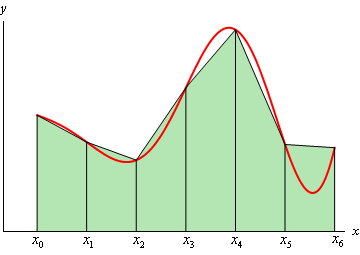 An example trapezoidal approximation of a function f(x), notated by each x interval. Courtesy of Paul's Online Notes.
$$T(x) = \frac{h_1}{2}(y_0 + y_1) + \frac{h_2}{2}(y_1 + y_2) + \dots + \frac{h_k}{2}(y_{k-1} + y_k)$$ $$h_1 = x_1 - x_0,\space\space h_2 = x_2 - x_1, \space\space\dots,\space\space h_n = x_n - x_{n-1}$$
$$T(x) = \frac{h_1}{2}(y_0 + y_1) + \frac{h_2}{2}(y_1 + y_2) + \dots + \frac{h_k}{2}(y_{k-1} + y_k)$$ $$h_1 = x_1 - x_0,\space\space h_2 = x_2 - x_1, \space\space\dots,\space\space h_n = x_n - x_{n-1}$$
#
Rule .
In the special case of the Trapezoid Rule where h is a constant: The Trapezoid Rule can be simplified to
$$T = \frac{h}{2}(y_0 + 2y_1 + 2y_2 + \dots + 2y_{n-1} + y_n)$$
where [a,b] is partitioned into n subintervals of equal length h = (b-a)/n.
# Differential Equation: A Differential Equation is an equation involving a derivative. Three types of equations are used when two variables are changing at the same time.
# Functions with Discontinuities: The general solutions found using this method are only valid for continuous functions. So if a function contains discontinuities you need to restrict the domain to the continuous portion of the function that contains the solution. In order to make a discontinuous function have a particular solution, you must restrict the domain so that the point you want is included in the domain.
# Indefinite Integrals with FTC: The family of all antiderivatives of a function f(x) is the indefinite integral of f with respect to x written: $$\int f(x)dx$$ If f is a function such that F'(x) = f(x), then $$\int f(x)dx = F(x) + c$$ , where c is an arbitrary constant, called the constant of integration. Although Definite Integrals and Indefinite Integrals look similar, they are not all alike. A definite integral is a number, the limit of a sequence of Riemann sums; also represented by the area between a curve and the x-axis. An Indefinite Integral is a family of functions havin a common derivative.
#
Rule .
DEFINITE INTEGRALS HAVE UPPER AND LOWER LIMITS AND REPRESENT THE AREA UNDER THE CURVE. Indefinite integrals just have the integrand with no limits, and they find the family of functions with a common derivative. That's why indefinite integrals have +c and definite integrals don't.
# PROPERTIES OF INDEFINITE INTEGRALS:
$$\int k \cdot f(x) dx = k \int f(x) dx$$ , where k is some constant.
$$\int (f(x) \pm g(x)) dx = \int f(x) dx \pm \int g(x) dx$$
POWER FORMULAS:
$$\int u^n du = \frac{u^{n+1}}{n+1} + c$$ , where n ≠ -1.
$$\int u^-1 du = \int \frac{1}{u} du = \ln|u| + c$$
TRIG. FORMULAS: $$\int \cos(u) du = \sin(u) + c$$ $$\int \sin(u) du = -\cos(u) + c$$ $$\int \sec^2(u) du = \tan(u) + c$$ $$\int \csc^2(u) du = -\cot(u) + c$$ $$\int \sec(u)\tan(u) du = \sec(u) + c$$ $$\int \csc(u)\cot(u) du = -\csc(u) + c$$
EXPONENTIAL FORMULAS: $$\int e^u \, du = e^u + c$$ $$\int a^u du = \frac{a}{\ln(a)} + c$$
LOGARITHMIC FORMULAS: $$\int \ln(u) = u\ln(u) - u +c$$ $$\int \log_a(u)\,du = \frac{1}{\ln(a)} \int \ln(u)\,du = \frac{u\ln|u|-u}{\ln(a)} + C$$
#
Rule .
When a problem requires you to 'verify' an antiderivative, what you want to do is start from the side that doesn't have an integral (the antiderivative), and take the derivative of it. That's all.


