
These are my complete notes for Derivative Tests in Differential Calculus.
I color-coded my notes according to their meaning - for a complete reference for each type of note, see here (also available in the sidebar). All of the knowledge present in these notes has been filtered through my personal explanations for them, the result of my attempts to understand and study them from my classes and online courses. In the unlikely event there are any egregious errors, contact me at jdlacabe@berkeley.edu.
Summary of Derivative Tests (Differential Calculus)
?. Derivative Tests.
# Concavity:
Which way the graph bends or shapes, either 'up' or 'down', as defined below.
a) Concave up on an open Interval I if y' is increasing on I. This is the part of the curve on the position graph where the tangent line is on the *bottom* of the curve.
b) Concave down on an open Interval I if y' is decreasing on I. This is the part of the curve on the position graph where the tangent line is on the *top* of the curve.
# Concavity Test:
a) Concave up on any interval where y'' > 0.
b) Concave down on any interval where y'' < 0.
# Point of Inflection: A point on the graph where a tangent line exists and where the concavity changes (i.e., where the y'' changes sign).
#
Rule .
Properties of the Second Derivative (y''):
1. y'' = 0 does not always ive an inflection point. Sometimes both sides are the same sign, like in a parabola, or continually increasin or decreasing, like with x³. For example, with the function f(x) = x⁴, f'(x) = 4x³ and f''(x) = 12x². Although f''(x) = 0 at x=0, it cannot be considered an inflection point as the concavity doesn't change: f''(x) remains positive before and after.
2. y'' ≠ 0 can still be an inflection point, surprisingly. In the example f(x) = ∛x = x¹/³, f'(x) = (1/3)x⁻²/³, f''(x) = (-2 / 4∛x⁵). As evident, f''(0) is DNE, but it is also shockingly still an inflection point. An inflection point can occur where f''(x) = 0, or where f''(x) is DNE, since the only requirement is wherever f''(x) changes signs, regardless of continuity. To check, use the second derivative test.
1. y'' = 0 does not always ive an inflection point. Sometimes both sides are the same sign, like in a parabola, or continually increasin or decreasing, like with x³. For example, with the function f(x) = x⁴, f'(x) = 4x³ and f''(x) = 12x². Although f''(x) = 0 at x=0, it cannot be considered an inflection point as the concavity doesn't change: f''(x) remains positive before and after.
2. y'' ≠ 0 can still be an inflection point, surprisingly. In the example f(x) = ∛x = x¹/³, f'(x) = (1/3)x⁻²/³, f''(x) = (-2 / 4∛x⁵). As evident, f''(0) is DNE, but it is also shockingly still an inflection point. An inflection point can occur where f''(x) = 0, or where f''(x) is DNE, since the only requirement is wherever f''(x) changes signs, regardless of continuity. To check, use the second derivative test.
#
Rule .
Second Derivative Test Basics:
If f'(c) = 0 and f''(c) > 0, then f has a local minimum at x = c. It should look something like the following, with the tangent line drawn in red:
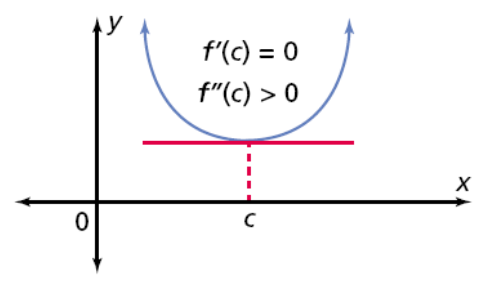 An example local minimum graph, with the first and second derivatives given and a red tangent respective to the concavity. Courtesy of Mr. Hardy's Virtual Classroom.
If f'(c) = 0 and f''(c) < 0, then f has a local maximum at x = c. It should look something like the following, with the tangent line drawn in red:
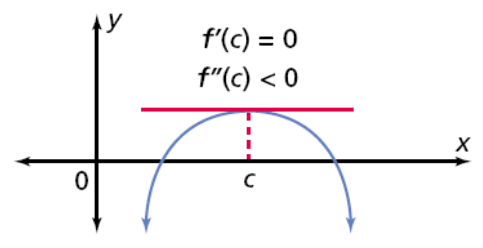 An example local maximum graph, with the first and second derivatives given and a red tangent respective to the concavity. Courtesy of Mr. Hardy's Virtual Classroom.
If f''(c) = 0 or DNE, the Second Derivative test fails. Go back & use the first derivative test. DON'T CONFUSE THE CONCAVITY TEST (see blue sec.) WITH THE SECOND DERIVATIVE TEST!!!!!!
If f'(c) = 0 and f''(c) > 0, then f has a local minimum at x = c. It should look something like the following, with the tangent line drawn in red:
If f'(c) = 0 and f''(c) < 0, then f has a local maximum at x = c. It should look something like the following, with the tangent line drawn in red:
If f''(c) = 0 or DNE, the Second Derivative test fails. Go back & use the first derivative test. DON'T CONFUSE THE CONCAVITY TEST (see blue sec.) WITH THE SECOND DERIVATIVE TEST!!!!!!
#
Rule .
First Derivative Test:
The first derivative test is used to find a graph's local minimum and maximum using the first derivative: to find these values, the points at which f is increasing and decreasing must be determined, which can luckily be found from the critical points on the derivative graph - the points at which f'(x) = 0 or DNE.
On the derivative, if f'(x) changes signs from positive to negative at c, then f has a local maximum. Vice verse for local minimums.
VERY IMPORTANT: Where f'(x) doesn't change sign, there are no extreme values. The endpoints are almost always extreme values because the graph generally increases or decreases right after them. To circumvent using the sign chart, just do the math before and after the Critical Points to find where it is increasing or decreasing and write, for example, "local max at x = -2 because f'(x) changes sign from + to -".
Remember that the sign going from positive to negative means a local maximum because that means a peak. When it goes from negative to positive, that is a minimum because it is a nadir.
The first derivative test is used to find a graph's local minimum and maximum using the first derivative: to find these values, the points at which f is increasing and decreasing must be determined, which can luckily be found from the critical points on the derivative graph - the points at which f'(x) = 0 or DNE.
On the derivative, if f'(x) changes signs from positive to negative at c, then f has a local maximum. Vice verse for local minimums.
VERY IMPORTANT: Where f'(x) doesn't change sign, there are no extreme values. The endpoints are almost always extreme values because the graph generally increases or decreases right after them. To circumvent using the sign chart, just do the math before and after the Critical Points to find where it is increasing or decreasing and write, for example, "local max at x = -2 because f'(x) changes sign from + to -".
Remember that the sign going from positive to negative means a local maximum because that means a peak. When it goes from negative to positive, that is a minimum because it is a nadir.
#
Rule .
Graphing Functions using Derivative Tests:
To graph a function, you need to know how the graph bends along its domain, which is to say its concavity(s). Where the graph has a tangent line along the bottom of the graph, it is concave up, and when the tangent line is on top, the graph is concave down. The graph is concave up when y' is increasing, or when y'' > 0, and vice verse for concave down.
To find the concavity, you have to find the Points of Inflection, or the points where f''(x) = 0 or DNE. These are like the 2nd derivative's own Critical Points. You find them by finding the points at which the 2nd derivative is equal to 0 or DNE, and then plugging in the values on either side to see if the 2nd derivative changes sign. From there, each interval of the graph that f''(x) is positive is concave up, and each that is negative is concave down, so you can write something to the effect of "concave up from (0,2) because f'(x) is positive along that interval" for your statement.
To graph a function, you need to know how the graph bends along its domain, which is to say its concavity(s). Where the graph has a tangent line along the bottom of the graph, it is concave up, and when the tangent line is on top, the graph is concave down. The graph is concave up when y' is increasing, or when y'' > 0, and vice verse for concave down.
To find the concavity, you have to find the Points of Inflection, or the points where f''(x) = 0 or DNE. These are like the 2nd derivative's own Critical Points. You find them by finding the points at which the 2nd derivative is equal to 0 or DNE, and then plugging in the values on either side to see if the 2nd derivative changes sign. From there, each interval of the graph that f''(x) is positive is concave up, and each that is negative is concave down, so you can write something to the effect of "concave up from (0,2) because f'(x) is positive along that interval" for your statement.
#
Rule .
There is a neat trick to check the minimums and maximums found in the first derivative test using the 2nd derivative. It allows you to avoid having to find the signs of the values around the Critical Points in the first derivative.
Only if f'(c) = 0 and f''(c) < 0 can f have a local maximum at x = c. Only if f(c) = 0 & f'(c) > 0 does f have a local minimum at x = c.
For example, if you get a Critical Point of -2 and the f'(x) = 6x, you can immediately know that x = -2 is a local maximum because the f''(c) is -12. Yes, it's backwards.
Only if f'(c) = 0 and f''(c) < 0 can f have a local maximum at x = c. Only if f(c) = 0 & f'(c) > 0 does f have a local minimum at x = c.
For example, if you get a Critical Point of -2 and the f'(x) = 6x, you can immediately know that x = -2 is a local maximum because the f''(c) is -12. Yes, it's backwards.
#
Rule .
DERIVATIVE TEST SUMMARY:
IN SUMMARY: The first derivative will tell us the minimums and the maximums, the critical points, and where the graph is increasing and decreasing. The second derivative will tell us the points of inflection and the concavity, as well as enabling a trick for the minimums & maximums. To find the intervals in which f is increasing, you need the first derivative and to find the points in between the Critical Points to plug into said derivative to see what intervals the graph is facing up, you need to know the 2nd derivative & the points of inflection, finding the points in between and plugging them in as before to find what intervals are positive and thus concave up.
To find what x-coordinates have local extrema, you use the same Critical Point from finding the increasing and decreasing intervals to determine whether they are between the increasing and decreasing intervals, which tells you what sort of extrema, if any, the point is. You would then combine all of this information together, combining two line graphs telling you what intervals the graph is increasing and the concavity of each interval. Then, graph accordingly.
IN SUMMARY: The first derivative will tell us the minimums and the maximums, the critical points, and where the graph is increasing and decreasing. The second derivative will tell us the points of inflection and the concavity, as well as enabling a trick for the minimums & maximums. To find the intervals in which f is increasing, you need the first derivative and to find the points in between the Critical Points to plug into said derivative to see what intervals the graph is facing up, you need to know the 2nd derivative & the points of inflection, finding the points in between and plugging them in as before to find what intervals are positive and thus concave up.
To find what x-coordinates have local extrema, you use the same Critical Point from finding the increasing and decreasing intervals to determine whether they are between the increasing and decreasing intervals, which tells you what sort of extrema, if any, the point is. You would then combine all of this information together, combining two line graphs telling you what intervals the graph is increasing and the concavity of each interval. Then, graph accordingly.


